All the oil has been sold, MashaAllah
Sign up to be notified first when the next batch of pure black seed oil is ready, InshaAllah!
We'll notify you as soon as the next batch is ready.
HOME / MEZIANA BLACK SEED OIL (100% PURE, UNFILTERED, FRESH) – PRESSED ON FEBRUARY 4, 2025
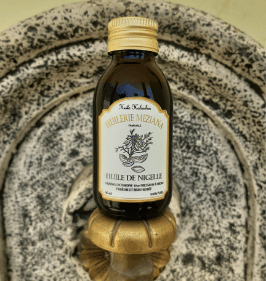
Estimated delivery between Tuesday 17 March and Sunday 22 March 2026 November, Insha’Allah.
We offer two types of pure black seed oil. The Meziana Forte: a black seed oil pressed from Habachia seeds grown and harvested near our family-run oil mill in Turkey, ensuring better quality control over the seeds. The Meziana Douce: a black seed oil pressed from seeds from the Cham region.
So which black seed oil should you buy?
The Meziana Douce has a milder taste. The Meziana Forte is richer but has a stronger flavor. For external application, we recommend Meziana Douce, as it is gentler on the skin. For consumption, if you are used to consuming Meziana Forte, then it remains the best choice. However, if you are new to black seed oil, we recommend Meziana Douce for its smoother taste. You can also order one of each to see which one suits you best.
In any case, both can be consumed and used for external applications. They are edible black seed oils for both dietary and external use.
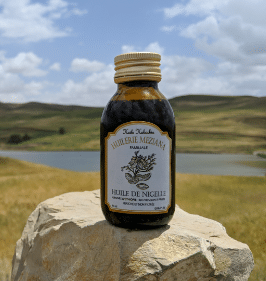
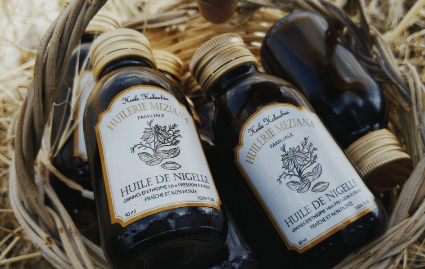
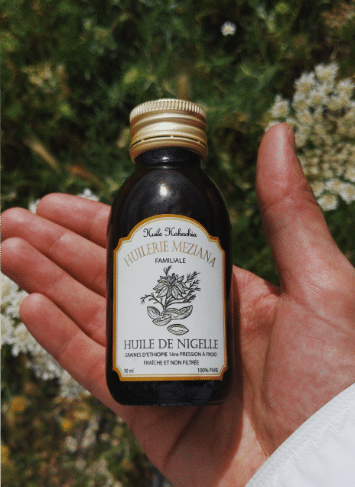
Our black seed oil is pure and contains only black seed oil—absolutely nothing else. We press our own oil with no additives whatsoever.
Many sellers are resellers who buy their oil from distant suppliers or even from other resellers. This chain of intermediaries creates serious traceability issues, to the point where even the final seller may have doubts about the true composition of the oil they are selling.
At Meziana Oil Press, we personally place the seeds in the press, we press the button to start the extraction, and we fill your bottles ourselves. We handle everything from A to Z with our own hands, without any intermediaries or subcontractors. That’s why we have no doubt that our oil is 100% pure.
Our black seed oil is cold-pressed, meaning it is extracted from black seeds using a press that does not generate heat, preserving all the beneficial properties of its composition.
Hot pressing would allow us to extract a larger quantity of oil from the seeds—making it more profitable—but it would alter its composition.
Between profitability and quality, we have chosen quality. That’s why our oil is cold-pressed, ensuring the best possible quality from the seeds, even if it means sacrificing quantity.
Meziana Oil Press black seed oil is unfiltered. Unlike the vast majority of other oils on the market, our oil remains unfiltered to retain all its natural elements.
An unfiltered oil contains sediments that give it its beautiful black color. These sediments are rich in antioxidants, phenolic compounds, and active ingredients.
You are guaranteed that our oil was pressed shortly before your order. We always display the pressing date on the product sheet and the bottle.
Filtered oils commonly found on the market are sometimes stored for months or even years before being sold, which affects their quality. Like many natural oils, some of the aromatic or nutrient components may diminish in strength over time depending on storage conditions.
Meziana black seed oil is pressed exclusively from either soft or strong black seeds (Habachia). It is characterized by a strong, slightly spicy taste and a beautiful black color.
The strong black seed (Habachia) is the most renowned, particularly in the Arab world and sub-Saharan African countries.
Its oil is considered more effective than black seed oils pressed from seeds originating from other countries such as Egypt or India.
Some laboratory analyses have shown a higher presence of natural compounds in these seeds. However, it has never been proven to be more effective for any specific illness. In fact, researchers conducting medical studies never mention the origin of the seed, which suggests that this criterion may not necessarily be significant in their eyes.
However, Meziana Strong black seed oil has a rather strong taste that some people may not appreciate. At Meziana Oil Press, we love it, but since taste is subjective, we have chosen to offer an alternative: a milder black seed oil pressed from seeds from the Cham region, called Meziana Soft.
Our pure oil is mechanically pressed, unlike other oils that may be extracted using chemical methods. No need to spell it out: harmful chemicals are used in the process and are supposedly filtered out afterward—of course, within a “tolerable” limit. As long as the remaining chemicals are below the legal threshold, it’s considered acceptable.
This is what’s known as refined oil—which we personally choose not to use in order to maintain a more natural product profile. This method may alter the oil’s original composition and reduce the concentration of some natural compounds.
We do not use any gasoline or diesel-powered press that would release harmful pollutants into the air, with particles that could settle on the oil. Instead, we choose to use a less powerful mechanical press that operates solely on electricity.
Even if this reduces our production capacity, we have no desire to turn our family-run oil mill into a polluting factory that would be harmful to our health, our environment, and the quality of our oil.
Numerous studies highlight the importance of low relative humidity when storing and processing seeds for vegetable oils.
This is why we carefully monitor the humidity levels in the air of our oil mill.
No more terrible plastic bottles. Certain plastics may release trace compounds into contents under specific conditions, especially heat exposure, which is why we use glass and stainless steel for safety. You’ve probably seen the infamous “Do not expose the bottle to sunlight” warning on plastic water bottles.
It’s true that some plastics are more toxic than others, such as:
Some plastics are considered safer and should be preferred:
However, even the safest plastics are not completely risk-free, as certain chemical treatments can make them harmful over time.
The safest choice remains noble materials like glass and stainless steel. That’s why at Meziana Oil Press, we prioritize these materials: our press and storage tanks are made of stainless steel, and our bottles are made of glass.
It has been proven that UV rays alter the composition of oil over time. That’s why it is important for us to package all our oils in UV-protected glass bottles,
ensuring that you can store your oil without the risk of degrading its composition.
We are a family-run oil mill, which means:
This does not mean we are perfect or free from mistakes—we are only human. As the Prophet Muhammad (peace and blessings be upon him) said: “All the sons of Adam are sinners, but the best of sinners are those who repent.” (Sunan Ibn Majah).
However, it does mean that we take great care to be truthful in everything we say about our products, to verify the information we share on our blog regarding the benefits of our oil, and to always cite our sources whenever possible.
Meziana black cumin oil for drinking is :
– 100% pure,
– first cold-pressed,
– unfiltered (to preserve all its elements),
– mechanically pressed,
– stored in anti-uv glass bottles
– And above all, it’s a freshly pressed oil (date of pressing on the bottle),
This makes it a high-quality oil, traditionally consumed in wellness routines, and produced with great care and attention to quality
How do you know if black cumin oil is edible?
Black cumin oil is traditionally consumed in various cultures, but not all oils on the market are approved for ingestion. Some black cumin oils available on the market are labelled “for skin and hair”, with no mention of edible use. This leads consumers to wonder whether they can drink the oil at all.
Only black cumin oils that are food-grade, clearly labelled for internal use, and approved by relevant authorities should be consumed.
So why do some sellers choose to indicate that their oil is for external consumption only, and particularly for skin and hair?
There may be several reasons for this:
– Some products may be labelled for external use only due to their intended positioning or because they haven’t undergone food-grade certification.
– In some cases, oils may be blended or refined, which may affect whether they are suitable for internal consumption..
– The oil has not been stored in the right conditions: too long or uncontrolled storage time, stored in the heat (and even worse if stored in the heat and in a plastic bottle)…
– The seller has done this as a marketing strategy. Indeed, if the seller believes that his main target is customers who buy oil for their skin and hair, it makes good marketing sense to specialize his product solely for these two uses.
In some markets, traceability may be limited when products are resold by intermediaries, which can affect clarity about origin or purity.
The third case is highly probable. Storage conditions such as the use of plastic or transparent bottles may impact the oil’s quality and shelf life. However, consumers are encouraged to choose oils that are clearly labelled and approved for internal use to avoid any doubt.
The fourth case seems to me the most likely. The seller has only indicated “skin and hair” as a marketing strategy.
When in doubt, it’s best to refrain from drinking it, and opt for edible black cumin oils without a shadow of a doubt:
– 100% pure from the producer (no traceability problems)
– Freshly pressed and packaged in glass, anti-uv bottles.
Disclaimer: This article is for informational purposes only and does not constitute medical advice. This product is not intended to diagnose, treat, cure, or prevent any disease. Always consult a licensed healthcare provider before using any supplement. This product is sold as a food supplement. Always consult a qualified healthcare provider before use.
Habachia black seed oil is widely regarded as one of the most renowned among black seed oils. It is particularly appreciated by consumers for its robust taste and traditional significance.
Its taste is noticeably stronger than that of most other black seed oils. But does this stronger flavor indicate a difference in composition or antioxidant profile?
In 2018, a Sri Lankan university conducted a comparative study analyzing the composition of Ethiopian black seeds (commonly used for Habachia oil) and Indian black seeds.
Here is how the researchers described their methodology:
“Black seeds of Indian and Ethiopian origin were purchased from a Sri Lankan company. Their quality parameters were tested, and they were stored under laboratory conditions. Powdered samples of each type were prepared by grinding and stored in separate glass containers for subsequent use. The extraction process was carried out by adding 5 g of powder to 50 ml of methanol and shaking the mixture overnight. The extracts were then centrifuged at 1100×g for 10 minutes, filtered using Whatman Grade 1 filter paper, and stored in brown bottles at 4°C. To determine total phenolic content, triplicate samples were prepared. For antioxidant capacity, DPPH and ABTS radical scavenging assays were used. Samples were again prepared in triplicate, with duplicate measurements taken for each replicate. The extracted solutions were maintained at 40°C for further analysis. Phenolic content and antioxidant capacity were measured in the seed coats, cotyledons, and whole seeds of both seed types.”
The study aimed to compare the antioxidant capacity and phenolic compound content of the two seed varieties. One of the key compounds of interest is thymoquinone, a major active component found in black seed.
It is reported in a hadith of the Prophet ﷺ that black seed has healing properties, except for death (Al-Bukhari, No. 5688).
Centuries later, in the 1960s, researchers identified thymoquinone as one of the primary compounds in black seed. Since then, hundreds of laboratory studies have explored its potential biological activities, including antioxidant, anti-inflammatory, and antimicrobial effects.
These findings have contributed to the growing scientific interest in black seed as a traditional wellness ingredient. As of now, over 1,200 studies related to Nigella sativa have been published by universities worldwide and are cataloged in the U.S. National Institutes of Health Library.
Numerous studies have investigated potential roles of black seed in supporting general wellness, including areas such as respiratory health, skin care, and metabolic function, although more clinical research is still needed.
The 2018 study specifically compared Ethiopian and Indian black seeds in terms of antioxidant potential and phenolic content—thymoquinone being one of the phenolic compounds of interest.
It is worth noting that the study did not isolate or quantify thymoquinone levels directly but focused instead on total phenolic content.
Here are the study’s key findings:
In summary:
Antioxidant capacity and phenolic content were higher in Ethiopian black seed than in Indian.
We are inclined to say yes—at least in terms of antioxidant potential. However, definitive conclusions require additional comparative clinical studies. For example, research could include:
To be conclusive, such studies would need to involve a large number of participants and measure outcomes for specific conditions.
Interestingly, most medical studies to date do not specify the seed’s geographic origin—perhaps because it is not considered a critical variable in clinical research.
In the meantime, based on current evidence, Habachia (Ethiopian) black seed showed higher levels of phenolic compounds and stronger antioxidant capacity—and continues to be among the most respected and appreciated varieties worldwide.
Sources:
[1] https://www.ncbi.nlm.nih.gov/pubmed/?term=nigella+sativa
[2] https://juniperpublishers.com/artoaj/pdf/ARTOAJ.MS.ID.556011.pdf
Disclaimer: This article is for informational purposes only and does not constitute medical advice. This product is not intended to diagnose, treat, cure, or prevent any disease. Always consult a licensed healthcare provider before using any supplement. Only consume or apply products that are approved by the relevant authorities.
Black cumin oil – whose scientific name is nigella sativa oil – is known by many different names, depending on the region or country. For example, there is no difference between nigella oil and black cumin oil, qude sanouj oil, habba sawda oil or black seed oil. All these names refer to the same oil.
Black cumin oil is called black seed oil, because black cumin seeds are tiny black seeds. It’s also called habba sawda (or habba saouda) oil, which is in fact the Arabic name for “black seed oil”. “Habba” being the Arabic word for seed and ‘sawda’ the Arabic word for black.
Black cumin oil is also sometimes used, perhaps because of the similarity between black cumin and black cumin seeds. As for sanouj oil, it comes from Algeria. Sanouj is the Algerian name for the black cumin seed.
At our family-run oil mill, we produce black cumin oil the traditional way—cold-pressed, pure, and free from additives or dilution. You can count on our commitment to craftsmanship, traceability, and natural integrity in every bottle.
No products in the cart.
Leave a Reply