DISCOVER
The Meziana Oil Press quality charter
Approved by more than 9,750 consumers and merchants
Context and Issue: Improving the Market for Black Seed Oil
Since the release of Meziana Oil Press’ video on the 11 quality criteria for black seed oil, the French market has undergone a significant transformation. With over 200,000 views in just a few months, this video has sparked a major awareness of quality standards, by the grace of Allah. We hope to bring this change to the UK too!
- Consumers have gained greater awareness of what defines traditional-quality black seed oil
- Sellers and producers have started to draw inspiration from the quality standards of Meziana Oil Press
Meziana Oil Press is a small family-owned oil mill that intends to remain that way, insha’Allah, particularly in order to maintain complete control over the quality of our black seed oil. Meziana Oil Press does not aim to become a factory for black seed oil.
It is therefore impossible for Meziana Oil Press to meet all the demand and supply the entire Middle East market. That is why, through this charter, we aim to encourage sellers and producers of nigella oil to continue drawing inspiration from these quality standards.
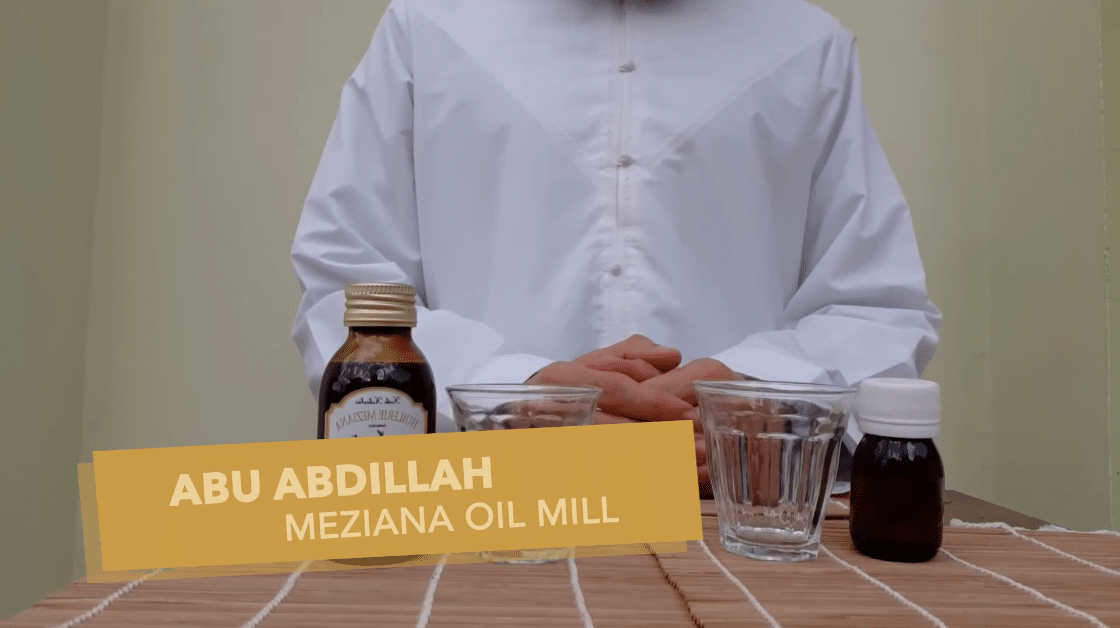
Objective: to encourage sellers and producers of black seed oil to continue drawing inspiration from this charter.
We thank Allah because, following this video, many black seed oil sellers have started to take inspiration from some of these criteria.
For example, one of the main quality criteria is that the black seed oil should be fresh, meaning consumed shortly after pressing. Before this video, there was no fresh black seed oil with a recent pressing date available on the French-speaking market. No one emphasized this aspect. Yet, it is an essential criterion because the active components of black seed oil degrade with storage. Today, by the grace of Allah, other black seed sellers are highlighting this as well.
In the end, it is the consumer who benefits, as those who use black seed oil as part of their traditional wellness routine have the right to expect transparency and freshness.
That is because we want to go further and encourage sellers to adopt other quality criteria, which is why we are publishing this quality charter.
Each criterion is inspired by best practices and supported, where applicable, by independent research, the references for which can be found at the bottom of the charter. Some criteria are mandatory, meaning they are essential for any respectable black seed oil. Others are recommended, meaning they allow for a richer and higher-quality oil.
Approve this charter to give it more weight and contribute to the improvement of the black seed oil market.
DISCOVER
The 11 quality criteria of black seed oil
1. 100% Pure (mandatory)
A black seed oil must be composed solely of oil extracted from black seed. No other oil or component should be added.
2. Freshly pressed with a recent pressing date (mandatory)
This is one of the most important criteria because the active components of black seed oil degrade with storage. A study [1] from Putra University in Malaysia observed that thymoquinone — one of the naturally occurring compounds in black seed oil — may decline over time when stored at room temperature, with reductions of up to 44% after 2 years.
3. Unfiltered (mandatory)
An unfiltered oil is an oil from which no element of the black seed has been removed. This type of oil is recognizable by its black color, due to the black seed deposits. These deposits are known to contain natural aromatic and plant-based components valued in traditional use, as shown in another study from Putra University in Malaysia [2].
Although a decanted oil (brown) or filtered oil (orange or yellow) is less rich, this in no way means that it is not pure. The color has no connection to purity. It simply indicates that the oil is less rich.
An oil can be filtered for convenience (for people who find unfiltered oils too strong, for example), and in this case, if the oil is pure and freshly pressed, it can still be a good oil. However, oils that are filtered for the purpose of being stored for a long time should be avoided. Indeed, a filtered oil can be stored indefinitely, but the problem is that the active components of a stored oil deteriorate very quickly.
Meziana Oil Press therefore recommends unfiltered oils as they are richer while acknowledging that a filtered or decanted oil can still be a good oil if it meets other criteria.
4. Cold-pressed (recommended)
The properties of black seed oil change when it is pressed at temperatures above 50°C, as demonstrated by a study conducted by Shahjalal University of Bangladesh and the University of Sains Malaysia.[3]
5. Ethiopian seed (recommended)
The Ethiopian seed is widely appreciated for its strong aroma, rich color, and traditional use (see the comparative academic studies on the subject [4]) and our article : Is Habachia black seed oil the most effective. The oil extracted from it is called Habachia black seed oil.
However, black seed oil can also be pressed for convenience from seeds of Egypt, Turkey, India, etc., as long as they are indeed Nigella sativa seeds. Indeed,
Habachia black seed oil pressed from Ethiopian seeds is very strong in taste, and some people may not tolerate it. The same applies to the skin; those with more sensitive skin will appreciate a gentler oil pressed from other seeds.
6. Mechanically pressed (mandatory)
Black seed oil extracted mechanically is richer (notably preserving its natural aromatic compounds) than oil extracted using chemical solvents, as shown in the studies [5]. Additionally, consumers prefer oil extracted without chemicals.
7. Electric motor pressed (mandatory)
Black seed oil must be pressed using a press equipped with an electric motor, not a thermal engine (such as a diesel engine), in order to avoid the pollution caused by this type of engine, which is harmful to health and the environment, and whose particulate emissions can pollute the oil. [6]
8. Controlled humidity of the oil mill (recommended)
Many studies show the importance of low relative humidity during the storage and processing of seeds intended for vegetable oils. [7]
9. Glass bottle (recommended)
Plastic has a harmful effect on both human health and the environment, as demonstrated by numerous medical studies [8].
10. UV-protective bottle (mandatory)
Numerous studies [9] indicate that exposure to UV accelerates the oxidation of vegetable oils, which may affect the oil’s composition and freshness over time.
11. Traceability (mandatory)
The consumer has the right to demand total traceability of black seed oil from production to purchase. Traceability ensures that the various stakeholders take responsibility in case of issues, which in turn improves the product’s safety and health standards.

Even more quality criteria
There are still other good practices that Meziana Oil Press implements. However, we have chosen to focus the charter on the essential points.
References of the studies
[1] Recent Pressing. Click here to access the study
[2] Unfiltered. Click here to access the study
[[3] Cold Pressing. Click here to access the study
[[4] Ethiopian Seed (Habachia). Click here to access the study
[5] Mechanically pressed. Click here to access the study
[6] Electric motor press. Click here to access the study
[7] Controlled humidity of the oil mill. Click here to access the study
[8] Glass bottle. Click here to access the study
[9] UV-protective bottle. Click here to access the study
Leave a Reply